
TikTok Ads Pricing in 2026: Complete Guide to Costs, Bidding, and Budgets
A detailed breakdown of TikTok advertising costs in 2026, including minimum spends, CPM ranges, bidding strategies, and how to calculate realistic budgets for campaigns at different scales.
TikTok has become a critical advertising channel for brands targeting younger demographics and performance marketers seeking efficient acquisition. But understanding TikTok ads pricing requires more than knowing the minimum bid. Real costs depend on audience targeting, creative quality, campaign objectives, and competitive dynamics in your vertical. This guide covers everything you need to know about TikTok advertising costs in 2026.
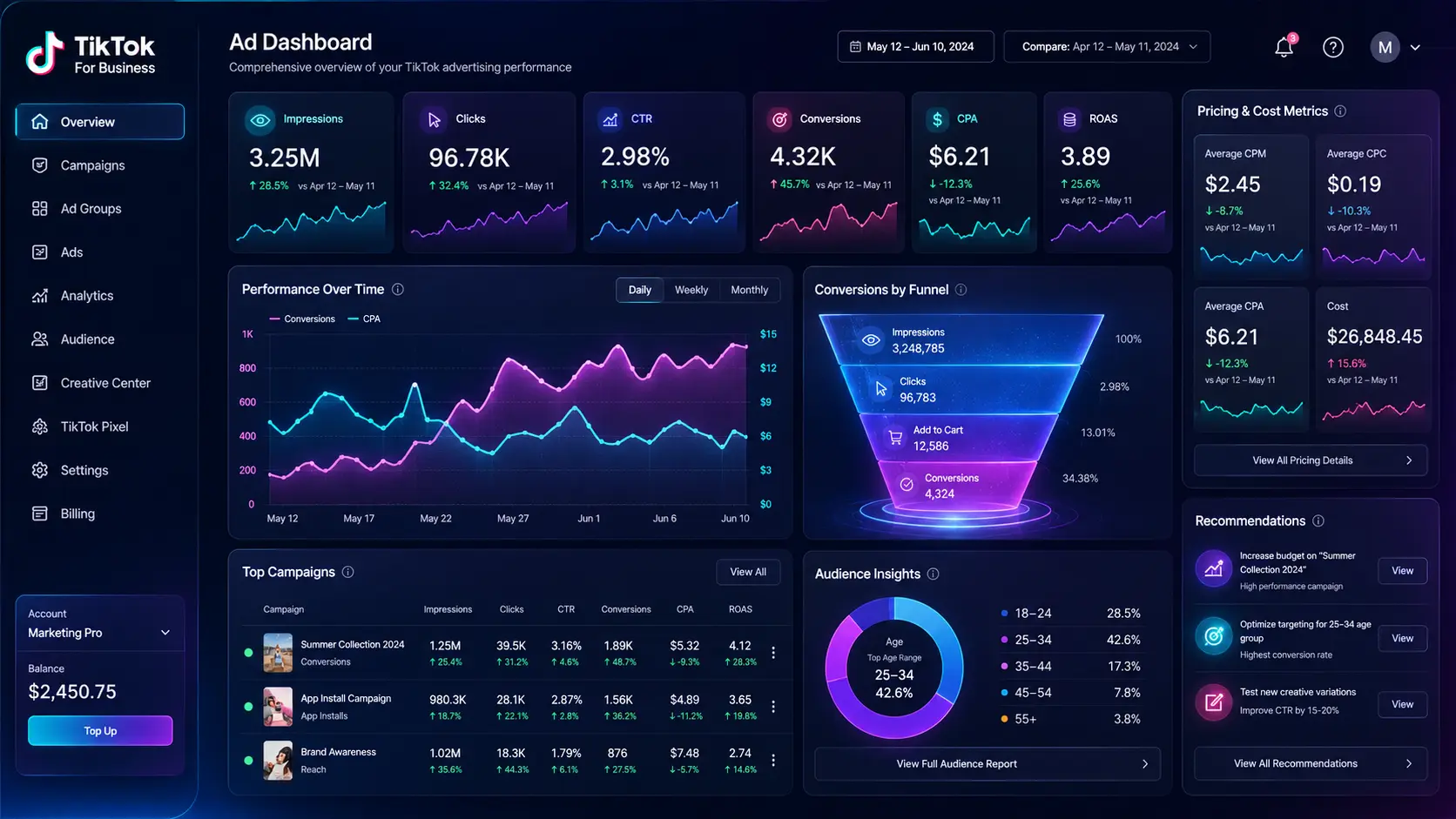
Minimum spend and account requirements
TikTok advertising requires a minimum daily budget per ad group, which typically starts around twenty dollars per day depending on the account currency and region. This minimum applies to each ad group, not each campaign, so a campaign with five ad groups would have a minimum daily spend of one hundred dollars. For testing purposes, start with the minimum budget to validate audience and creative before scaling.
Account-level minimums may also apply. Some TikTok ad accounts require a prepaid balance to be maintained, and certain industries or regions may have higher minimum thresholds. Work with a TikTok representative or authorized partner if you need accounts with higher spending capacity or specialized features unavailable to self-serve advertisers.
CPM and CPC ranges by objective
TikTok uses auction-based pricing where costs vary based on competition for your target audience. In 2026, typical CPM ranges from three to fifteen dollars for broad awareness campaigns in competitive markets. More targeted audiences, especially in high-value verticals like finance and technology, can see CPMs of fifteen to thirty dollars or higher. Cost-per-click typically ranges from fifty cents to three dollars, again depending heavily on audience and vertical.
Campaign objective significantly affects pricing. Reach campaigns, designed for maximum impressions, typically have lower CPMs than conversion campaigns where TikTok optimizes for specific actions like purchases or sign-ups. The trade-off is that lower-funnel objectives produce fewer impressions but higher-quality traffic. Choose objectives based on your funnel stage and optimization goals.
Bidding strategies explained
TikTok offers several bidding strategies depending on campaign objective. Maximum delivery, also called lowest cost, spends your full budget and gets the most results possible at the lowest cost per result. This strategy works well for testing and early campaign learning phases. Cost cap, also called target cost, attempts to maintain an average cost per result near your target while spending your budget. This strategy provides more predictable unit economics for scaling.
Bid cap, or maximum cost bid, sets an absolute ceiling on what you will pay per result. This strategy can limit spend if your cap is below what the auction requires to win impressions. Use bid cap carefully: setting it too low may prevent your ads from delivering at all. For most advertisers, cost cap provides the best balance of control and delivery volume.
Budget allocation for testing
For initial creative testing, allocate enough budget to generate statistically meaningful results. A common mistake is testing too many creatives with too little budget each, resulting in inconclusive data. Better to test three creatives with sufficient spend each than ten creatives with inadequate data. As a starting point, allocate at least one hundred to two hundred dollars per creative variant to allow the algorithm to optimize and produce reliable performance signals.
Structure your testing budget by variable. If you are testing hooks, keep the rest of the creative identical. If you are testing audiences, use the same creative across audience segments. This controlled variable approach allows you to attribute performance differences to the specific element being tested, which accelerates learning and reduces wasted spend on ambiguous results.
How creative quality affects costs
Creative quality is the largest lever on TikTok advertising efficiency. Higher-performing creatives win more auctions at lower effective costs because the algorithm rewards engagement and conversion signals. A creative with two times the click-through rate of an alternative may cost significantly less per click even though the bid is the same, because TikTok's auction rewards predicted performance.
This dynamic means that investing in creative production often pays for itself through lower media costs. A professionally produced UGC video that performs fifty percent better than amateur alternatives can reduce your effective CPM by a similar margin. Calculate the break-even point: if better creative costs five hundred dollars more to produce but saves five hundred dollars in media costs within the first week of testing, the investment pays back immediately.
Industry benchmarks and realistic expectations
Performance varies dramatically by industry, product price point, and target audience. E-commerce brands typically see cost-per-acquisition ranging from fifteen to fifty dollars depending on product category and average order value. Mobile app install campaigns often see cost-per-install between one and five dollars for gaming apps and five to fifteen dollars for non-gaming categories. Lead generation campaigns in professional services can see cost-per-lead from twenty to one hundred dollars depending on lead value.
Use these benchmarks as starting points, not targets. Your actual costs depend on your specific audience, creative, and offer. Track your own performance history and optimize against your own baselines rather than generic industry averages. The most valuable benchmark is your own improving efficiency over time.
Hidden costs beyond media spend
Total TikTok advertising cost includes more than the media budget. Creative production costs, whether in-house or through agencies or creator partnerships, often exceed media spend in early testing phases. Tool subscriptions for creative management, analytics, and automation add ongoing costs. Agency fees or internal labor costs for campaign management should be factored into true cost-per-acquisition calculations.
When presenting total advertising costs to stakeholders, be transparent about all cost components. Media-only reporting understates true acquisition costs and can lead to unrealistic expectations about scaling efficiency. A campaign with twenty dollar media CPA and thirty dollar total CPA after production and management costs is still performing well, but only if everyone understands the real economics.
How to apply this guide in makeads
Use this guide as a practical checkpoint for planning AI UGC videos, comparing creative angles, and deciding which parts of your workflow should be scripted, generated, reviewed, localized, and tested first.
The most useful next step is to translate the advice into one production brief: define the audience, the opening hook, the proof moment, the actor style, subtitle requirements, and the metric you will use to decide whether a video variant is worth scaling.
Related focus areas for this topic include TikTok Ads, Social Media Advertising, Ad Pricing, Digital Marketing. If you are building a campaign library, connect this guide with your pricing assumptions, platform policy checks, and localization plan before creating the final export.